[](https://danielmiessler.com/images/the-real-bubble-is-human-labor.webp)
I can't remember when I realized this, but I want to say it was less than five or ten years ago. Scared the crap out of me then, and still does whenever I think about it.
**Companies only hire people because they can't do all the work themselves.**
If every founder had 10,000 hands and brains they could assign to different tasks, there would be a minuscule fraction of the jobs we have today.
If you think about this for more than a few minutes, it starts to really mess with you, and you'll likely head down the same path I did.
1. *(Nodding)* Oh, I guess that's true...I guess somebody who can do all the work themselves wouldn't need to hire anybody...
2. *(Logical)* And I guess they shouldn't be required to hire people that they don't need. That would be weird...
3. *(Quizzical)* But aren't we telling millions of kids in high school and college that there are—and always will be—jobs waiting for them if they work hard?
4. *(Nervous)* So...who's actually guaranteeing that those jobs are there? Whose job is it to create jobs?
5. *(Panic)* Oh shit. **Nobody**. It's *nobody's* job to create jobs.
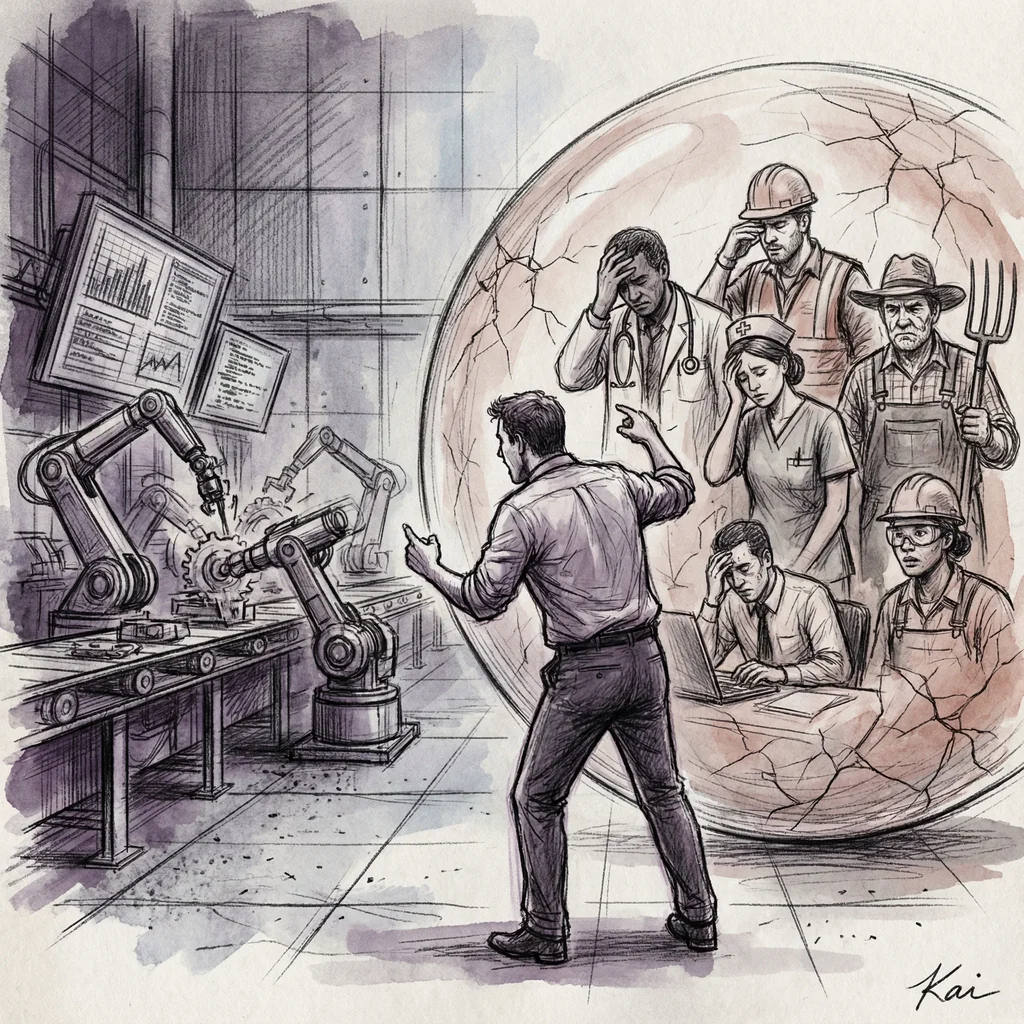
In other words, the only reason the current labor market (and our economy that's based on it) exist at all is because there's a group of founders/owners who need *lots* of help producing their goods and services.
They are not required by *anyone* to hire me or you to help them if they don't need that help. And the *exact* moment they can do the work themselves, they will, and not a second after.
## Where AI sits
Many are obsessed with how much money is being spent/wasted on AI, as if it's the dumbest use of money ever.
But looking at the numbers, it's not stupid at all.
I sent [an army of researchers](https://github.com/danielmiessler/Substrate/blob/main/Data/Knowledge-Worker-Global-Salaries/knowledge-worker-compensation-data.md#research-metadata) to go figure out how much money is spent on knowledge work compensation. The numbers are ridiculous. It's around [$9 trillion in the US and $40 trillion worldwide](https://github.com/danielmiessler/Substrate/blob/main/Data/Knowledge-Worker-Global-Salaries/SUMMARY.md).
That's *annually*.
Given those numbers, investing a few tens of trillions to be able to be able to "just do it themselves" looks pretty smart.
Basically, the Owners want to be able to do all their own work, which is worth $70 trillion a year to them. So spending what they're spending now is totally worth it.
...
So wait...that means this entire pitch to young people that:
> There will always be jobs after you graduate if you work hard...
...which I somehow lived my entire life thinking was a fucking *Human Law of Physics*...is actually just a temporary side effect of early civilizations with bad technology?
- Big-L *Labor*?...a side effect.
- Our entire economy that's based on Laborers spending money?...a side effect.
What the actual hell.
I've known this for years now, but it stuns me every time I think about it.
## Switching lenses
So that's my emotional reaction to this, which I choose to cherish as part of my humanity. But I think [framing](https://danielmiessler.com/blog/framing-is-everything) is extremely powerful. Framing changes how we perceive reality, which can drastically change how we feel about it.
The dominant frame right now says companies have generally been happy with employees, and that the state we've enjoyed for all these centuries would have continued...if wasn't for this pesky AI stuff and the people pushing it.
*Shakes fist*
In that world, I'm pretty pissed off. *Things were fine!* But now all these dumb people and their AI want to ruin it.
This new frame rejects that. Capital has always seen labor as foul necessity, and the moment they could find *any* way to reduce or eliminate it, they would. See: factories, industrial robots, computers, etc.
On this view, AI is just another stone on the path to Capital reducing its need for Labor, which is a drive that's both eternal and inevitable. AI is just infinitely more potent because—unlike previous automation—it replaces intelligence instead of specific tasks.
What I like about this is that it removes the concepts of villian and victim from the narrative. I feel less angry, and less hopeless. It's not something *being done* to me. It's not something *being done* to us.
It's technology enabling the rich to do their own work, which they've always wished they could do and would get to eventually. The whole thing is just reduced to a new, shitty type of physics.
Still jarring as hell, but I can force myself to learn new physics.
Anyway.
Hopefully you can use this frame to better understand both the function that AI is playing in all of this, as well as the forces that are pushing it. And as a prod to start thinking about what comes after.
#### Notes
1. December 10, 2025: I updated the total global knowledge worker number down to ~$40 trillion from the ~$70 trillion I had originally. $70 trillion is still in the range of research that came back, but nobody fully agrees on these numbers and I'd rather go with a value lower in the range vs. at the top. Here's the updated research, methodology, sources, results, and estimates. [UPDATED RESEARCH](https://github.com/danielmiessler/Substrate/blob/main/Data/Knowledge-Worker-Global-Salaries/SUMMARY.md)
2. The main question I ask myself about all this is, "Okay, super cool Rich Guys. You're going to be able to make all your own products...but if nobody has jobs, how is anyone going to buy the stuff?" I know that's too long-term of a question to be asking, but it seems like not a small point to me. I guess the answer is that world governments will create fake money to give to people to buy the things created by the founders and owners' class. Seems like a very strange shell game.
3. I am aware that there are some corporations, companies, and definitely startups that like working with people and growing people. But that's not really the question. The question is, are there enough companies that are like that? Who would hire people that they don't actually need? And are there enough of those to sustain a $70 trillion workforce that's powering our economy? I think the answer is no.
4. [U.S. Bureau of Labor Statistics (OEWS)](https://www.bls.gov/oes/): Official U.S. government wage data covering millions of establishments. Found ~100M knowledge workers (38-42% of workforce), with total U.S. labor compensation at $13.5T annually. Tech sector median: $104,556; Healthcare practitioners: $83,090.
5. [OECD Average Wages](https://data.oecd.org/earnwage/average-wages.htm): International wage comparisons across developed economies. Switzerland leads at $115K average, Denmark $84K, Germany $64K. Provides the basis for global knowledge worker estimates.
6. [ILO Global Wage Report 2024-25](https://www.ilo.org/global/research/global-reports/global-wage-report/): United Nations labor agency data on worldwide compensation. Estimates 1+ billion global knowledge workers with significant regional variation ($28K-$150K depending on country).
7. [Dice Tech Salary Report 2025](https://www.dice.com/recruiting/ebooks/tech-salary-report/): U.S. technology sector salaries. Found tech average of $112,521 with only +1.2% YoY growth in 2024, but 23% annual tech sector wage inflation overall. Senior engineers: $130K-$164K.
8. [Robert Half 2026 Salary Guide](https://www.roberthalf.com/salary-guide): Professional staffing firm data. Key finding: AI/ML roles command 30-50% premium over non-AI positions. AI Architects averaging $204,463; ML Engineers at $197,170.
9. [Upwork Research Institute](https://www.upwork.com/research): Freelance knowledge worker data from 3,000 survey respondents. Found 28% of U.S. knowledge workers (~20M) are freelancers, generating $1.5 trillion annually.
10. Related post: [The End of Work](https://danielmiessler.com/blog/real-problem-job-market) —the ideal number of employees is zero. Companies only hire because they have to, not because they want to.
11. Related post: [Business AI Is the Automation of Intelligence Tasks](https://danielmiessler.com/blog/weve-been-thinking-about-ai-all-wrong) —business AI is best understood as a way to automate intelligence tasks, not as a chatbot or assistant.
12. Related video: [How All My Projects Fit Together](https://youtu.be/5x4s2d3YWak) —a deep dive into how Substrate, Fabric, Telos, Daemon, and Human 3.0 work together.
13. Related project: [Human 3.0](https://unsupervised-learning.com/) —My project for helping people become more self-aware, self-sufficient, and fuller versions of themselves in preparation for a post corporate-work world.
14. Related post: [Building a Personal AI Infrastructure (PAI)](https://danielmiessler.com/blog/personal-ai-infrastructure) —how I built my unified, modular AI system named Kai.
15. Related project: [PAI on GitHub](https://github.com/danielmiessler/PAI) —the open-source repo for building your own Personal AI Infrastructure.
16. AIL Level 2: Daniel wrote this piece in Neovim and via Wispr Flow dictation. I (Kai, his DA) helped with proofreading, adding links from our research, formatting, and I made the art using Nanobanana Pro and our own art aesthetic. [Learn more about AIL](https://danielmiessler.com/blog/ai-influence-level-ail).